Friday, January 29

I know You're NOT Gonna Let THAT Stop you!

So you're fed up with school, work, or whatever else is occupying valuable time you could be making music! And problems are piling up like the bills on your coffee table! Your significant other thinks you’re insignificant and sends you a break up text. Your Job is downsizing and it looks like you’re next... and on top of ALLLLL THAT, it looks like it's going to rain tonight!

But HEY! ... are you going to let all of THAT stop you from attending The IdOMusic Networking Event TODAY?!?!?!?!

HOPE NOT!

Come out to find your next creative team, learn from established professionals, or just enjoy the music filled atmosphere! It's going to be GREAT!

TODAY - January 29, 2009 // 8PM

Venue Information:
30 Courtland Street, Atlanta, GA 30303 (Building on the corner on Gilmer St. and Courtland St. on across from Georgia State University Student Center)

View Directions: http://tinyurl.com/ydalvc9

The Panel:
"WERKING Your Way iN!" - The Music Industry is one of the most guarded. What you have to do to gain access?

The Panelists:
Ivory Weems // Artist Development/Marketing/Video Production and assistant to C.O.O of DTP

Big Ron // CEO of Black Shield Music Group, Executive Producer, Independent A&R Consultant

Keinon Johnson // National Director of Urban Promotions at Interscope Records

Frances Crawford // Client Relations, PatchWerk Recording Studios

Spotlight Artists & Producers:
Ajae
JayCobz
Dj Freak
Soundboy
Dizzywunda
Simp
Nike'
JusNice

Admission: $12
-Student Discount w/ Student I.D. - $10
-AIA Students: Contact Joe Shiver in Career Services...
-AES Members: Contact Selah.Abrams@turner.com


What's your take... leave your comments below.

Tuesday, January 26

IdOMusic® Mania BLINK 182


IdOMusic® Mania FACEBOOK Contest! Every week IdOMusic® will post new contest for the members of our IdOMusic® group to participate in and win IdOMusic® Tee shirts and/or tickets to our IdOMusic® events.

This week contest instructions (CLICK HERE) is to view the pictures posted answer the questions that is posted under the picture as a caption. Answer under the picture with the correct answer. Also answer the question for the video posted. You will have to submit your answer for the video in the wall comment area. For every answer that is correct we will keep tallys. Whoever has the most answered correct will win the prize. Leave all comments regarding the contest on the comment wall here in the IdOMusic® Mania page. Invite all of your friends to participate. Have fun!!! Bringing together the worlds music makers. IdOMusic®

1 - Find all the I dO Music® Logos. How many is in this photo?

2 - Name 3 songs by blink 182?

3 - What genre is blink 182?


What's your take... leave your comments below.

Social NetWerking for music makers.


Twitter

Currently enjoying its status as a media giant, Twitter recently topped the annual list of the most popular words and phrases within the English language, as compiled by language trend tracker Global Language Monitor, and rated #2 (behind “Michael Jackson”) in Microsoft search engine Bing’s list of the year’s most-searched topics. Applications for songwriters and composers are predictably multitudinous, which can make navigating it a bit tricky.

As with Facebook, users of San Francisco-based Twitter (http://twitter.com/; free membership) have a personal site where they can receive and send information. On Twitter, information is sent in short, 140-character blog posts called “tweets” to the author's subscribers who are known as “followers.” Such information can be sent in a number of ways, including email, text messages, and instant messages.

There are several music-sharing applications within the Twitter-verse, wherein the user can upload a song or find it through a music search engine and then share it with his followers. A user can, of course, include recordings of his own songs, but beyond the user’s truly close friends, it’s unlikely that the music will reach the ears of a music business exec. (And blindly inundating an exec with MP3s nets the same result as mailing them unrequested demos: that is, zero.)

Instead, the most practical approach for budding composers on Twitter is to seek out like-minded users via its search engine, and become followers. Typing in “songwriting tips” or “collaborate music” can result in dozens of hits; thanks to the 140-character limit, perusing those results can be quick and (relatively) painless.

The advantages of being on Twitter are not limited to those struggling to get into the business. Hip-hop artist Jim Jones reported in an interview that once he tweeted about the availability of his then-new single, “Dancing On Me,” on iTunes over the summer, “It started at the 100’s and slowly but surely in a few days it started climbing in the 50’s and 40’s, you know? So appreciate everybody for going and buying that record off the help of the tweet.”

MySpace

Beverly Hills-based MySpace (http://www.myspace.com/; free membership) was the first social network to gain widespread attention, being named the most visited Internet domain for U.S.-based users by web monitoring company Experian Hitwise in July 2006. Since then, however, it’s been mostly downhill, as Facebook and Twitter have taken over most of the buzz; a November report by web metrics company Compete showed that MySpace had lost a fifth of its U.S. traffic since June, with over five million users leaving just in August alone.

The game may not be over, however. In April, Owen Van Natta, former CEO at online music venture Playlist and Chief Revenue Officer at Facebook, was named MySpace CEO, and is actively exploring a number of options for a redesign (a recurring complaint amongst users) and, possibly, some kind of joint venture with Facebook itself.

MySpace built its reputation in part by being so music and musician friendly, and there are signs that the company may be heading back in that direction. The company relaunched its MySpace Music page (http://music.myspace.com/) in the fall of 2008, which includes musician profiles that allow artists and songwriters to upload their music, provided they control the rights to do so. Unsigned acts can also use the service to post and sell their music.

That still leaves the issue of getting people to want to purchase your music, of course. As with Facebook and Twitter, MySpace is home to any number of specialized groups, including those designed and maintained with the up-and-coming songwriter in mind. A recent search for “songwrite collaborate” returned 28,600 results, and such established groups as American Songwriter Magazine, New Jersey Songwriters in the Round, the World Independent Music Association, and the Vienna Songwriting Association all maintain MySpace accounts.

Next: YouTube and LinkedIn


What's your take... leave your comments below.

3 easy steps to branding your name.


Branding yourself as an artist is becoming more and more important. Year by year you see more and more "celebrity brands" springing up and there is a definite reason why. Branding yourself creates opportunities and generally increases cash flow for the artists that engage in branding.

Why is this? Because the more and more familiar you are with a thing the more you trust them. This is why people like P. Diddy and Oprah can "touch" an item or service and it magically takes off. You can have this same power too (just most likely on a slightly smaller demographic). Below are a few examples and ways that you can begin to brand your band.

Adding your url to all your stuff and promoting it during shows - This is one of the easiest things you can do. You simply add your band website address to every item you sell or give away as swag (freebies). Post it on t-shirts, posters, and of course your cd. During shows you could have banners posted behind you showing your band website url too. Also take the time to state that you can be found online and at what address too. The idea is to get as many people as possible to see and recognize yourband.com with being associated with you.

Business cards and stationary items - Handing out business cards and stationary are a great way to brand yourself. Business cards are cheap to get and easy to create. Your contact information (especially your url) should be placed on front and your band logo on the backside. This is very simple but works well. Pass them out to as many people as you can and little by little you’ll be branding your band for as little as five dollars at some print shops like Vista Print.

Using logos on everything - Your logo is your greatest branding tool. Companies like McDonald’s, Coke-A-Cola, and Pizza Hut for years have been using their great logos to brand themselves with consumers and so should you. It helps if you begin to think of your band as "your band inc." rather than just an indie garage band. Throw your logo onto everything you can think of online and off. This should be your calling card too. Once the general public knows your logo and associates it with you you’ll find you’re in really good company locally. Think of bands like Kiss and The Rolling Stones years after there prime people can still identify them by seeing their logos.


What's your take... leave your comments below.

Monday, January 25

IdOMusic® Spotlight: Ivory Weems(DTP)

You can check out Ivory Weems speaking about "WerkIN Your Way In The Business" Friday January 29th at The IdOMusic® Networking Event!


What's your take... leave your comments below.

Saturday, January 23

Who's Werking?

Studio 995


Saxaphonist, Mike Phillips, whose influences have stemmed from his love of Hip Hop plus traditional jazz music, was in PatchWerk Studios working on his 3rd Album entitled "MP3" which will be released this spring on "Hidden Beach Recordings". Tracks for the new Album feature production from Atlanta based Producers "Q.Coleman, and Eric Jackson, of 310 MUSIC GROUP". All Mike Phillips' sessions were engineered by PatchWerk engineer Mike Wilson.

International pop singer Ebru just released her first single '' Love Soundz '' to I-tunes. It is the first single from the German singers Upcoming EP that includes 6 more songs. Ebru stopped through PatchWerk for a couple days to work with producer Hot Sauce and PatchWerk engineer Mike Wilson.

Spanish pop singer, Mala Rodriguez was in PatchWerk Studios for over 3 weeks finishing the first part of the recording of her next album. This new album, the 4th one in the Spanish rappers career, is without a doubt, her most avant-garde and elaborated work. The album will have production from American producer, Focus (Dr Dre, Beyonce, Busta Rhymes, J.Lo, Christina Aguilera… and the Spanish producers Griffi and Sr Tcee). All Mala’s sessions were assisted by PatchWerk engineer’s Dee Brown and Tripp Tiller.

Big Bank Black, CEO of Duct Tape Entertainment, and feature artist on Kandi Burress’ “Try It Out’ was in PatchWerk for several days working with PatchWerk engineer Kori Anders. Trey Songz also stopped through PatchWerk this past December to work with artist Amaye. Together they spent a day working with PatchWerk engineer Mike “Snotty” Miller.

Other sessions in 995 included those for PRGZ (M. Wilson) , Brothers Keeper (m. Wilson), Mars (M. Wilson), Avant Garde Entertainment (D.Brown), Cartoon (M. Wilson), Prynce CyHi (M.Solis), Drumma Boy (K. Anders), Street Hustle(M. Wilson), Nomad (M. Wilson), Lupe Fiasco (K. Anders), Sean Garrett (M. Walker/T. Tiller), Dorrough (M. Wilson), Heed (D. Brown), Playa K (Demitrius/D. Brown), Khia (M. Wilson/D.Brown)


Studio 9000


Sean ‘Diddy’ Combs came through PatchWerk for a day with Dirty Money and Sean Garrett. Last Train to Paris is the upcoming fifth studio album by Diddy and is scheduled to be released in 2010 on Interscope Records. In April 2009, with Dawn Richard of Danity Kane and singer Kalenna, Diddy formed the group Dirty Money, which will perform on this album. Diddys session was engineered by Miles Walker assisted by PatchWerk engineer Tripp Tiller.

Producer, Songwriter, and Rapper, Polow Da Don was in PatchWerk for a couple days this past December. He was working with singer, rapper Teyana Taylor. Taylor's debut album is called From a Planet Called Harlem. She has not announced a release date. Although she has yet to release a full length album, she has recorded a number of singles "Google Me," and "Traffic stop" . Polow's and Teyana's sessions were engineered by Jeremy Stevenson assisted by PatchWerk engineer Brian Pedersen.

Young Jeezy is working on Thug Motivation 103, his latest LP, as of July 2009. Thug Motivation 103 is the fourth studio album by rapper Young Jeezy. The album has no confirmed collaborations yet. Production will include tracks by JR Rotem, Scott Storch, Just Blaze, J.U.S.T.I.C.E. League, Beewirks, Kanye West, Sakwe and The Inkredibles. This past December Jeezy was in PatchWerk Studios having songs mixed by Leslie Brathwaite assisted by Brian Pedersen.

Ludacris and Nicki Minaj were having work done at PatchWerk this past December as well, having songs mixed by Leslie Brathwaite assisted by Brian Pedersen. After Nicki Minaj released her Beam Me Up Scotty, mixtape in 2009, she officially signed to Young Money Entertainment with distribution from Universal Motown wherein she will release her debut studio album in 2010.

Other sessions in 9000 included those for the Outlawz (M. Miller), Wacka Flacka (M. Miller), Ryan Toby (K. Anders), Alley Boy (K. Anders), and Musiq Soulchild Photo Shoot with Derek Blanks.


Studio 1019


Raekwon was recently in PatchWerk with Dow Jones of Tha Bizness. In December 2009, Raekwon's fourth studio album and latest effort Only Built For Cuban Linx... Pt. II was chosen as 'Album of the Year' on major hip hop site HipHopDx Awards. This past December he was putting in more work with PatchWerk engineer Dee Brown.

Recording artist and producer, B.o.B. AKA Bobby Ray Simmons was in PatchWerk’s studio 1019 this December for several days. B.o.B. is currently signed under the labels of Grand Hustle and Atlantic Records. He has described his influences as "80's music, Rap, techno, rock, funk, even du wop…" His debut album, The Adventures of Bobby Ray, was released in 2009 under T.I.'s record label Grand Hustle.

Other sessions in 1019 included those for Yelawolf, Prynce CyHi (M. Solis), Money Red (T. Tiller), Pastor Troy (M. Miller), Righteous (M. Solis), Playa K (Demitrius/D. Brown), and Def (B. Pedersen)


What's your take... leave your comments below.

Reasons songwriters need the PROs!


ASCAP, BMI, and SESAC are United States Performing Rights Organizations (PROs). Effectively, they all do the same thing. PROs issue blanket licenses to music broadcasters, such as television and radio stations, auditoriums, larger restaurants and clubs, hotels, or theme parks. Basically, they are issued to anyone who plays music in a public manner. By paying the blanket license fees to the PROs, these broadcasters are able to use whatever music they want without having to account to each individual songwriter. The blanket license fee’s amount is based on broadcast reach; a large commercial radio station pays a higher blanket license fee than a small bookstore, but both pay.

The PROs keep track of the music that is being used through playlists at radio stations, cue sheets on television, and by sampling, for other types of users—such as polling restaurants and bars to determine what music they are playing. They pay royalties to writers based on the number of times an affiliated songwriter’s music is used.

You affiliate with one (and only one) of the PROs so that they will be able to find you and send you performance royalty checks. The affiliation process is easy. There may be an inexpensive, one-time affiliation fee, but once you’re affiliated, there is no cost to register as many songs as you write at no further cost. Check out each PRO, choose one, and affiliate. They all do the same thing, as far as getting you paid goes, and neither is better than the other two, though their additional benefits and services vary.

Please note that PROs are not publishers. Registering your songs with them does not mean you have a publishing deal. PROs simply monitor the public use of copyrights and facilitate royalty payment for these uses.

Here is the info for the PROs:

ASCAP

One Lincoln Plaza

New York, NY 10023

212-621-6000

www.ascap.com


BMI

320 West 57th Street

New York, NY 10019-3790

212-586-2000

www.bmi.com


SESAC

55 Music Square East

Nashville, TN 37203

615-320-0055

www.sesac.com


What's your take... leave your comments below.

Thursday, January 21

Quincy Jones to remake "We are the world" for Haiti


Quincy Jones and Lionel Richie are planning a massive 25th anniversary re-recording of "We Are the World." In the wake of the Haiti Disaster, the timing couldn't be better, sadly enough.The duo is summoning lots and lots of talent from Grammy weekend to stay an extra night - Monday Feb. 1 - and come to the Nokia Theater in Los Angeles. There, they will celebrate a quarter century since Ken Kragen, Richie and Michael Jackson organized the original "We Are the World" with Jones.


This time the artists invited include Usher, Natalie Cole, and John Legend. But you can bet that more names will be added shortly and that all the Grammy nominees and participants will be asked to come as well. Grammy producer Ken Ehrlich will produce the event, which will then be turned into a video and single just like it was in 1985. Don't be surprised if Wyclef Jean joins in, along with Sting, Fergie, Alicia Keys, Justin Timberlake and other distinctive voices.

It's hoped that as in 1985, everyone will "leave their egos at the door."
Can this remake be as legendary as the original?


For More on this story visit http://www.billboard.com/


What's your take... leave your comments below.

Musicians 4 Haiti - MEISA Haiti Relief Event Monday


By now, we have all heard about the tragedy in Haiti. If you have wanted to help but couldn't decide on how to do it, this may be the event for you.

IdOMusic® & MEISA (Music & Entertainment Industry Student Association) wants to support the relief efforts to rebuild Haiti. In doing so, we propose to bring together the strengths of a multitude of musicians in an effort drive the forces together – collectively bringing relief to needs of the Haitian state.

It is our responsibility and our duty to make a difference now! We all have enough power to positively impact the lives of others. Take ACTION NOW! RSVP @ This link

WHEN: Monday, January 25th @ 30 Courtland Street, Atlanta, GA (GSU Alumni Hall) - 5:30p-9:30pm

DONATION: At least 3 items from the list below. Feel free to bring more donations if you are able to do so. Here is a list of items that are most needed according to the American Red Cross:

Monetary Donations
Canned Goods
Lightly Used/ New Apparel
First Aid Supplies
Water Purification Tablets
Neosporin
Alcohol Swabs
Aspirin
Hydrogen Peroxide
Vitamins
Thermometers
Peanut Butter
Pork
Beans
Self Rising Flour
Snacks
Protein Powder
Powdered Milk
Baby Formula
Baby Food and Bottles
Water
Towels
Bedding
Soap
Flashlights with Batteries
Tarps for makeshift shelters
Matches and candles

Operation Haiti will also include Hope 4 Haiti Arts & Crafts (where you can make cards and custom Hope necklaces and bracelets for the survivors), Video Support Station (where you can record a positive message for those who have been effected by the tragedy), and much more...

There will also be FREE FOOD.

We encourage you all to come out and support this worthy cause; together we can and WILL make a difference.


What's your take... leave your comments below.

Wednesday, January 20

Universal Music Group Hits Recession


If you've wondered how some labels have been affected by the recession other than not having a lot of money to go around here's Universal Music Group's story.

Universal Music Group has "let go" of 50 people as of yet and the count continues. Other than the UMG spokesman confirming the lay offs with the following statement," Universal Music Group is continuing to transform our organization to better serve our artists and business partners. Given the current economic climate, we have to be as agile and efficient as possible."

Seems like everyone is dealing with the wrath of the recession. Any ideas or thoughts on making it better for the newcomers? Read more on the original article here.

I Said it. You Be The Judge.


What's your take... leave your comments below.

Tuesday, January 19

More Music Events Than You Can STOMACH!

An important part of progrssing your career in music is attending events and rubbing shoulders with all the right people (or ALL people if you're socially savvy) - For starters... Here's a list of about 30 upcoming events you could attend courtesy of Fusicology.com

EVENTS GALOR HERE~~~>http://www.fusicology.com/homepage/currentatl.html#save


Fusicology.com is a multifaceted website media entity, promoting progressive music culture through event listings and relevant content. Fusicology as a whole provides a national hub reaching trend setting multicultural urbanites. Our site and newsletter specialize in providing relevant information for early adopters that include the musically forward.

For more information go to http://www.fusicology.com


What's your take... leave your comments below.

Basic Guide to Making Your Own Music


Preparing Your Music


Step 1
After meeting the other creative people you need from attending the IdOMusic® Networking Event - you're now ready to create a song. Select instrumentations, write vocals, and arrange your composition.

Step 2
Rehearse your written material.

Step 3
Develop a repertoire of your own songs, unless you want to produce only one track. Once you develop a repertoire, you can begin to think about gigging, starting perhaps with open-mic nights. This will help you develop the confidence you'll need when recording.


Recording Your Music


Step 1
Consider booking a recording studio if you want to compete with other commercially released music. To find a few studios simply type in something like "Studios in Atlanta (or where ever you are)" in google or another search engine. PatchWerk Recording Studios is certainly one of the top recording facilities in the country - go to www.patchwerk.com to see pictures, and inquire about rates. Recording your own music, depending on the type of recording you've decided to make, can be very difficult, involving investing in and then learning how to use many new pieces of equipment. Booking a recording studio allows you to farm out some of this labor to a knowledgeable person who already has equipment.

Step 2
If you do decide to "Do it Yourself" then one way is to do the pre-production on your own and then take it to a professional to get it mixed and mastered. Head to your local musical supply store if you decide to create a home studio. In-person advice is preferable to buying everything online (at least your first time out), since a knowledgeable musician or tech in a shop can steer you toward the right equipment.

Step 3
Set up your home studio. This might be as simple as plugging in a one-input tape recorder or as complicated as creating a soundproof space and integrating several new machines with each other and your computer.

Step 4
Record your material. You need to set aside specific time to do this, just as when you are rehearsing, but be prepared to leave even more time since you want to get the best tracks you can. Also, unless you are recording all the musicians playing together live, you'll need to set aside the time to record each one playing her part several times for quality and matching to the other tracks.

Step 5
Put on the finishing touches. Raw tracks aren't CD-ready yet. Your music will need to be mixed and mastered if your want to compete! These are the most tedious steps in creating a recording, so it is recommended that you hire a professional (i.e Patchwerk Studios). After mixing and mastering your record you're ready to print and promote. See some of our other articles for tips on marketing your music.

Visit www.patchwerk.com for additonal information.


What's your take... leave your comments below.

The Current Role of Mixtapes

The impact of mixtapes on the music industry has been detrimental at this point in Hip Hop and R&B. Extremely successful new Hip Hop artists, such as Drake and Nicki Minaj, have used this kind of music compilation to build their brand and establish a secure foundation in the Industry. Hip Hop artists such as 50 Cent and Fabolous also see the importance in using mixtapes as a different venue of musical expression. To the rest of the Music Industry, the significance of what was once considered a minor step in an artist's career, has become very evident in the recent years.


Check out what has been said in the debate on mixtape albums:

http://www.mtv.com/bands/m/mixtape/news_feature_021003/index3.jhtml


What's your take... leave your comments below.

Saturday, January 16

CCMixter Music Networking


CCMixter releasing music is communication. Nowadays, that means participation and that is what ccMixter offers. It is a combination of the two, letting fans and music people participate and communicate together, with you, with me and create new music and ideas.”DJ Vadim

CCMixter is a community music site featuring remixes licensed under Creative Commons where you can listen to, sample, mash-up, or interact with music in whatever way you want.Remixers If you’re into sampling, remixing and mash-ups grab the sample packs and a cappellas for download and you can upload your version back into ccMixter, for others to enjoy and re-sample. All legal.Video makers, podcasters and music lovers If you’re into music, browse this site to hear some of the great remixes people have built from sampling music on this site, all licensed for use under Creative Commons license.


What's your take... leave your comments below.

Starting a Record Label 101

Whether you're a member of an unsigned band or just an avid patron of local music, starting your own record label is a great way to get the unheard music you love out to the public. Here's how.

Step 1 - Choose a name for your record label. It should be something catchy that you would be proud to be associated with. Also consider choosing a name that fits with the genres of music that you intend to release.

Step 2 - Search the Internet once you've chosen a name to see if there are any other record labels or companies with the same name.

Step 3 - File a fictitious name statement with the secretary of state or registrar of deeds in the state where your record label will be based. This will give you the right to do business under your label's name, and they will perform a search of their database to be sure that no one else already owns the rights to the name. For this reason, it might be a good idea to have a couple of label names as backup so you don't waste a trip.

Step 4 - Decide on what form of business your label will claim for tax purposes. There are basically three forms to choose from. The first is a sole proprietorship, which is a single owner who accepts the responsibility of all of the profits, losses, risks and liabilities of the label. The second is a partnership, which is usually started by a duo or band that wish to share all the control and responsibility of the record label. And finally you could choose to form a corporation, which is a separate legal entity that protects the owners (known as stockholders in this case) from the brunt of liabilities associated with the label.

Step 5 - Obtain a business license from the city or county business license office, or request one through the mail. There is a small fee, but the license will allow you to legally operate your new record label as an official business.

Step 6 - Create a record label logo and start thinking about how you are going to market your image. Ask what you have to offer bands that are willing to sign to your label, and be prepared sell yourself at a moment's notice.

Step 7 - Convince artists and bands to sign to your label. Approach your favorite local bands and tell them why it would be in their best interest to join your label.

Click here for original post


What's your take... leave your comments below.

What makes some musical tunes cheerful and some sad?


Scientists at Duke University in Durham, North Carolina have revealed why tunes in major keys such as Singin' in the Rain, sound cheerful, while those in minor keys ?" like Pink Floyd's Another Brick in the Wall— sound gloomy and depressing.
Said that it is partly because the patterns of pitches in major keys mirror those of excited speech, whereas minor keys parallel-subdued speech. This suggests that language shaped our musical expression of emotion.

Several factors affect music's sentimental influence, like a fast, loud, jumpy rhythm sounds happy because it reflects the way an excited person behaves, and slow, quiet music with a regular beat mimics a mournful emotional state.

But, what researchers could not understand is why tunes in major keys tend to sound cheerful, whereas those in minor keys sound sad. "This is an age-old problem in music theory," New Scientist quoted Dr. Daniel Bowling, a neuroscientist at Duke, as saying. He suspected emotional speech patterns might be behind the link.

Thus, the researchers first measured the distribution of tones in around 7500 western classical melodies and Finnish folk tunes in both major and minor keys. They found, for instance, that minor thirds ?" with the melody note pitched three semitones above the tune's keynote ?" made up 15 per cent of tones in minor pieces, but unsurprisingly made up less than 1 per cent of tones in major pieces.

The researchers then compared these musical intervals with those between important tonal frequencies in spoken vowelsMovie Camera uttered by American English speakers in either excited or subdued voices.
Their speech samples came from ten volunteers who were recorded reading various monologues, including animated accounts of winning the lottery and morose descriptions of failing marriages.
As expected, the frequency relationships in excited speech closely matched those of music in major keys, while those of forlorn speech matched minor music.

Bowling added that his team found the same association for Mandarin Chinese speakers, suggesting the link is common to different cultures, if not universal. "This makes a good case that it has biological roots," he said. The study has been published in the Journal of the Acoustical Society of America.


What's your take... leave your comments below.

Friday, January 15

Huge Mistakes Made

There are so many wonderful Music Makers out there in the world with great talent and undeniable passion. Although many have the skill needed in order to be successful, most have not done the research necessary to know what's what. Key elements, such as a professional submission of your work and an expertise level of understanding of what it means to brand and market, can make a world of difference in who notices you... and who doesn't. Do your homeWERK and find out what's important to the people who drive this business. The following link will give you a few more pointers.

http://www.musicmarketing.com/2008/04/top-10-mistakes.html


What's your take... leave your comments below.

Ear Power


All music-makers should know how important ear training is for their development. Also experienced professionals still need to stay in shape, especially with the rhythm. A fundamental requirement for a musician is to be able to imitate sounds you hear in your imagination or from the outside world. You should be abAdd Imagele to replay those sounds using your voice or an instrument, and this is the real task for any player or composer.

Technically this is what making music means. Musicianship starts here! A professional musician, especially one with the perfect pitch may consider this as childish. On the contrary, even a pro should strive to improve his/her ability to memorize and replay sophisticated rhythm patterns. This contributes to better musical phrasing. Of course, music comes from the soul, it is not a mere juggling with sounds, but too many times players from a lower spirituality platform look better just because they have "a good ear". A common misconception is that this cannot be improved. From experience, I can assure you that the attentive ear can be improved to the highest levels. It requires a lot of practice and discipline, of course!


What's your take... leave your comments below.

NINJAM


What is NINJAM?

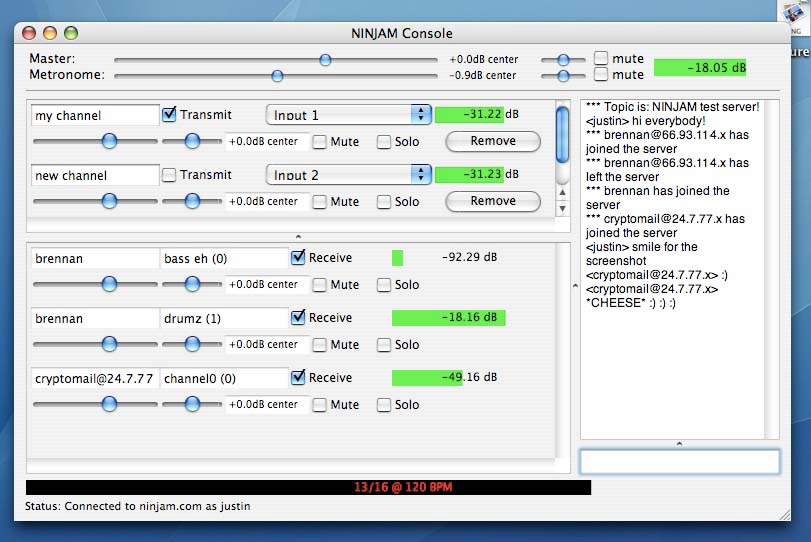
NINJAM is a program to allow people to make real music together via the Internet. Every participant can hear every other participant. Each user can also tweak their personal mix to his or her liking. NINJAM is cross-platform, with clients available for Mac OS X and Windows.

NINJAM uses compressed audio which allows it to work with any instrument or combination of instruments. You can sing, play a real piano, play a real saxophone, play a real guitar with whatever effects and guitar amplifier you want, anything. If your computer can record it, then you can jam with it (as opposed to MIDI-only systems that automatically preclude any kind of natural audio collaboration).

Since the inherent latency of the Internet prevents true realtime synchronization of the jam2, and playing with latency is weird (and often uncomfortable), NINJAM provides a solution by making latency (and the weirdness) much longer.

NINJAM uses OGG Vorbis audio compression to compress audio, then streams it to a NINJAM server, which can then stream it to the other people in your jam. This architecture requires a server with adequate bandwidth, but has no firewall or NAT issues. OGG Vorbis is utilized for its great low bitrate characteristics and performance. Each user receives a copy of other users audio streams, allowing for each user to adjust the mix to their liking, as well as remix later. This uses more bandwidth than having a server encode a single stream, but has numerous benefits (including lower server CPU use and the client having the full multichannel data for later use).

NINJAM can also save all of the original uncompressed source material, for doing full quality remixes after the jam.

For some samples of how NINJAM can sound, see samples directory.


What's your take... leave your comments below.

Where Do You Fit In? Define Your Role.


Where Do You Fit In? Define Your Role!
Mixing your craft with your passion always produces the best work. But intertwining the two is easier said than done. Listed below are some positions in the music industry and their trade. It’s time to define your role!

Artist Manager - An artist manager is in charge of the business side of being in a band. Often, band members are great at the creative side of things, but aren't so great at promoting themselves, booking their own gigs, or negotiating deals. In a very general sense, the task of a manager is take care of the day to day running of the band's career, so the band can focus on the creative side of things

Music Promoter - The main job of a music promoter is to publicize a concert. Promoters are the people in charge of "putting on" the show. They work with agents, or in some cases, directly with the bands, and with clubs and concert venues to arrange for a show to take place. Promoters then are in charge of making sure the word gets out about that show. They also take care of arranging the incidentals, like hotels and backline for the band. In a nutshell, it is the promoter's job to make sure things go off without a hitch.

Music Agents - Music agents, talent agents, or simply agents, are the people who make the live music happen. Agents work closely with promoters and record labels to make sure they bands on their books are getting the proper exposure. Music agents also take care of the negotiations with promoters and venues when it comes to the pay for performances and to arrangements for things like backline and accommodation.

Record Producers - The record producer works with the band, sessions musicians and the studio engineer to "produce" the sound the recordings. Often the producer's job is to provide an extra set of ears, to produce a certain sound or to provide experience. They may be involved with arranging parts of the track or even writing it.

Music Journalists - Naturally, music journalists write about music and the music business, but there are a few different specializations that exist under that heading. Other journalists tend to do more in depth pieces about musicians - they do interviews and cover the people behind the music. Some music journalists focus on writing about the music business itself - and still other writers do a mixed bag of work, combining music reviews, artist interviews and whatever else comes up that warrants press attention.

Cover Art Designer - A cover art designer is really simply a graphic designer who happens to focus on music related projects. Often, designers who work on cover art and liner notes also dabble in designing posters, t-shirts and other merch for the artists with whom they work, although not all do. The extent of a designer's input into the finished album artwork and liner notes can vary greatly from job to job, depending on what the musicians and/or label wants.


What's your take... leave your comments below.

Thursday, January 14

How can a new act stand out from the crowd?


So many artists are battling for the online exposure. Which is why it is difficult to filter through all the white noise, and makes trusted sources more important than ever.


On Monday, the Featured Artist Coalition held a technology showcase to help artists find new ways of getting their music to the public. The heads of companies like Spotify, SongKick and SoundCloud made short presentations before taking questions from the audience. One artist asked: "You all have great ideas, but how can I make sure that my music manages to break through 95% of rubbish that's clogging up the internet?" After one of the panellists admitted that the majority of music on his service was, indeed, rubbish, they all agreed that this was a problem for which no one has been able to find a proper solution.

It's been a while since people realised that having thousands of "friends" on MySpace doesn't provide much promotional power. YouTube has millions of videos battling for eyeballs and, as with Spotify, most are directed towards music that they already know or which has been suggested by friends or the media. Presented with endless options vying for your attention, filtering is more important than ever.

You can read this entire article at: http://www.guardian.co.uk/music


What's your take... leave your comments below.

Ready to Promote Your Music But Dont Know Where to Start?


Top Ten Tips for New Musicians and Bands

Many times great musicians and bands remain a secret to the world. Why? Because those great musicians and bands don't quite know how to market themselves. Sometimes they are a little intimidated at the thought of "tooting their own horn." Marketing your music is a lot easier than you may think and it all begins with a good press kit.

Don't freak out! A press kit is not difficult to put together. It's not mysterious or incredibly expensive. A press kit is simply a demo of your music along with pictures and information about you and/or your band. After putting your press kit together using the following ten tips, you'll be ready to market your music to the world.

1. Be Professional - Your music may be creative, even bizarre, but the theme of your press kit should be all business. This doesn't mean your press kit should sound stuffy. It just means that you should keep it professional while putting forth a "hip" image of you and your music. Agents, reps, radio stations, and club owners get tons of press kits and most of the time they are not put together well. Don't make a bad impression on someone who could make or break your career. If you present a professional press kit, you will give the reader confidence in your talent and dedication to your career. Besides, many times people will look at your press kit first before deciding whether to listen to your demo. If your press kit is good, your demo will be heard.

2. Be Honest - Don't lie in your press kit! You only have one chance to generate interest in your music. The people you will send your press kit to see press kits every day. They know who is desperate, who is all hype, and who has talent before even listening to your demo just based on the contents of your press kit.

3. Keep Personal Information Limited - It's great to give the reader an idea of where you or your band came from, but they really don't need to know about how you played Tiny Tim at the age of seven in your church's production of "A Christmas Carol." Remember the term "less is more" when writing a bio about you or your band. Keep your bio brief and to the point. Nobody will read a twenty page bio. Keep it to one page. If you include too much personal information, it will come across to the reader that you don't have any professional experience to include. Make sure you talk about your music more than you talk about your life. Make comparisons with other famous musicians and tell the reader what your music sounds like and why your music is special.

4. Quotes and Clippings - Including copies of legitimate clippings in your press kit adds credibility. These can be anything published about your music - from a newspaper article to a review of your cd. Good clippings and reviews will lead the reader to want to listen to your demo. In addition, include a quote sheet with quotes from legitimate sources. Don't include a quote from your mom saying how talented her baby boy is! Ask for quotes from people involved in the business like club owners, reviewers, and even from people who have bought your cd!

5. Upcoming Gigs - A list of your upcoming performances shows that you have actually performed for real people, that you have more performances coming up, and it gives the reader an anonymous chance to come and see you perform live without having to commit to anything first. If you have a particularly special performance coming up, consider including free tickets in your press kit when possible. If not, offer free tickets in your press kit to the reader if they call to let you know they want to attend.

6. Pictures - Include live performance pictures and at least one professional posed picture that reflects the image of your music. The posed picture should look like something appropriate for a cd cover. Put the name of your band and your contact information on the back of every picture.

7. Your Music - Never send a press kit without a high-quality, professionally recorded cd! Don't write the name of your band with a marker or apply a stick-on label to your cd. Have professional cd inserts made with your picture on the front of the cd and a song listing on the back. Don't send an old scratched and cracked cd case. Invest in new plastic cases. In addition, include the name of your band and your contact information on your cd and cd insert.

8. Cover Letter - Always write a personalized cover letter to include with your press kit. It should be addressed to a specific person and give a reason why you are sending the press kit. Don't forget your contact information, including your phone number, website, and e-mail address.

9. Package it Up - Put your press kit materials together in a nice folder. Consider being artistic and creative with your folder and even come up with a logo for your name or the name of your band. Take care in assembling your press kit folder so that your cd won't be broken and your pictures won't be bent during shipment. In addition, mail your press kit in a new envelope of an appropriate size and don't over-tape the envelope so that it is impossible to open.

10. Mail it to Yourself - Take the time to step away from your press kit for a few days and mail it to yourself. When it arrives in the mail, notice how the mailing envelope looks and how well the contents survived shipping. Read your press kit as if you don't know your band so you can judge whether it is professional and clear.

Putting together a good press kit isn't hard. Actually, it's a simple and effective way to promote you and your music. Always be on the lookout for new items to add to your press kit and for new people to add to your list of press kit recipients.

Click here for original post on www.taltopia.com


What's your take... leave your comments below.

Is it "Platinum" or Is it "Marketing?"


The RIAA has recently certified Rihanna's "Rated R" LP as platinum. The catch is it's only sold 500k. I hope you're just as curious as I was. Stuck between thinking is this fair? Or is her marketing team just that good? With the current state of the music industry, its no shock of how difficult it could be for an artist to put up satisfactory certifications such as going 1x, 2x, or even 3x platinum.

It debuted on the charts at #4, selling 181,000 units. Is Def Jam that compelled to make sure their artists remain "recession free" so to speak? Does it sound more appealing and drive consumers to purchase the album if we can say, "The platinum release Rated R by Rihanna"?

Is it fair to other artists who don't "jump the gun" on receiving their certification from the RIAA? Could it also just be a serious marketing strategy by Def Jam to make the album platinum by any means while it's still relevant so they can also use that to their advantage to push even more sales? Or will Rihanna's reign just not let up?

I Said It. You Be The Judge.


What's your take... leave your comments below.